
College Soccer Recruiting Is Broken and American High School Players Are Paying the Price
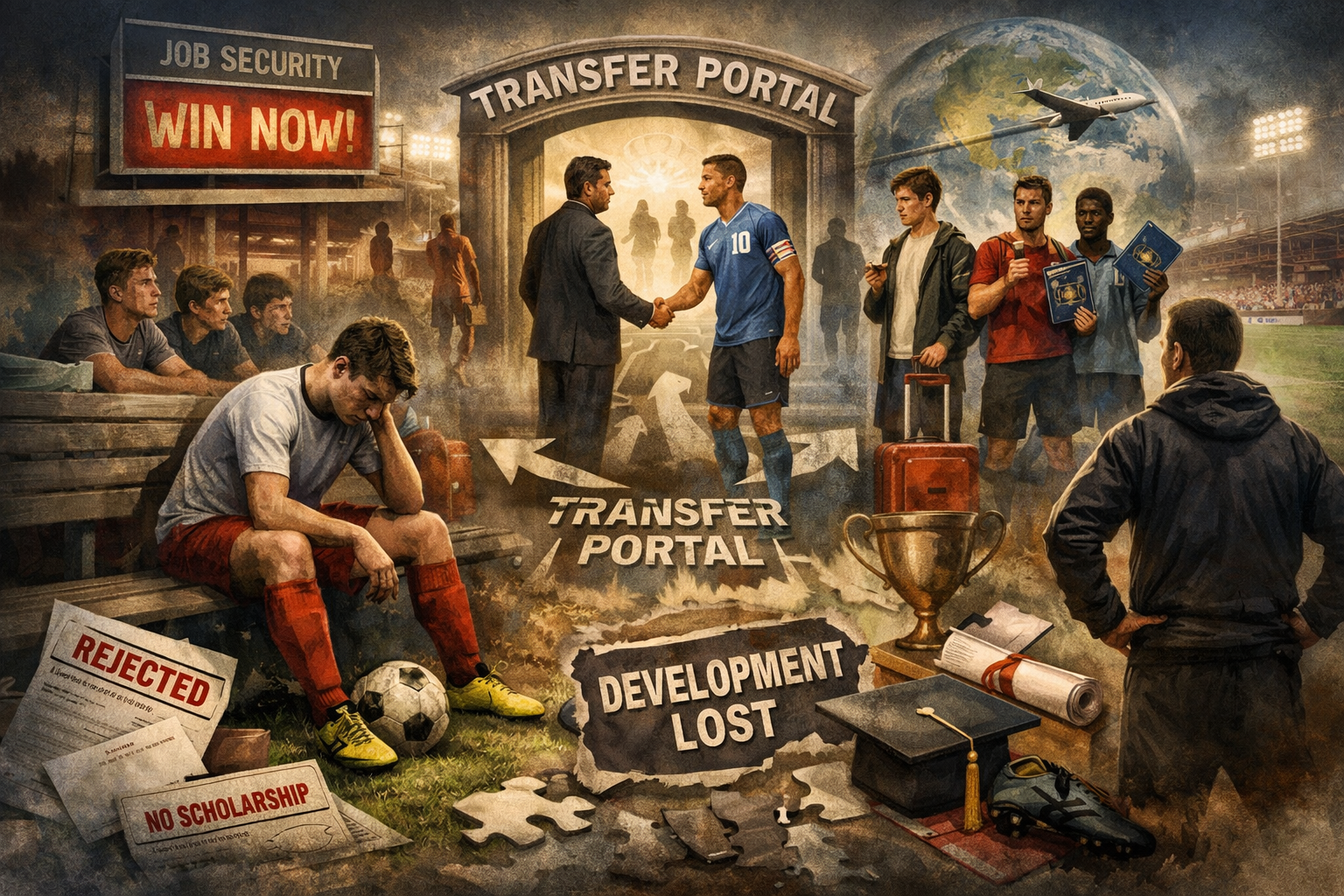
College soccer recruiting in the United States is not failing quietly. It’s failing in plain sight. And the group most affected isn’t the coaches, the administrators, or even the transfer portal itself—it’s the American high school–age player who is doing “everything right” and still finding fewer doors open. This isn’t a rant against progress or change. College soccer has evolved, and evolution is inevitable. But the current system has drifted away from its original purpose: development, education, and long-term program building. Instead, it has become a short-term marketplace where immediate results outweigh culture, and quick fixes often replace meaningful development.
Here’s why the system is broken—and how we can start fixing it.
1. The Transfer Portal: From Culture Building to Quick Fixes
The transfer portal has fundamentally changed how college programs are built. What was once a four-year developmental journey is now often treated like a rolling tryout.
Instead of recruiting freshmen to grow within a system, many programs are prioritizing players who can step in and contribute immediately. The portal offers certainty—game-ready bodies, college experience, and fewer unknowns. For coaches under pressure to win now, that’s a tempting solution.
The unintended consequence?
High school players are increasingly viewed as “projects” rather than investments.
Culture building—teaching standards, values, accountability, and identity over time—has taken a back seat to plugging holes year to year. Development is no longer the foundation; it’s a luxury. And when development disappears, so does patience for young American players who need time to adapt physically, tactically, and emotionally to the college game.
2. International Recruiting: Closing the Door on Local Talent
International recruiting, particularly on the men’s side, has become a dominant force in Division I soccer. To be clear: international players are not the problem. They bring quality, experience, and diversity that absolutely benefit college soccer.
The issue is balance. Many programs now look overseas before they look in their own backyard. As a result, highly capable local players—who understand the culture, the language, the academic system, and the long-term demands of the program—are being passed over.
College soccer was once a powerful development pathway for American players. Now, for many high school athletes, it feels like the door is closing before they ever get a real chance to knock.
The goal isn’t to eliminate international recruiting. It’s to challenge coaches to ask a better question:
Who around me can help build this program—not just win the next game, but strengthen the culture for the next four years?
3. The Pressure to Win in a Non-Profitable Sport
Here’s the reality no one likes to say out loud: college soccer is not a revenue sport. Yet coaches are evaluated almost entirely on wins and losses.
That pressure shapes decisions. When job security depends on results, long-term development becomes risky. Culture takes time. Freshmen make mistakes. Building standards require patience. And patience is hard to justify when the scoreboard is the primary metric. So coaches lean toward players who are physically mature, experienced, and immediately reliable—even if that comes at the expense of culture, graduation rates, and player experience.
Ironically, this short-term mindset often undermines the very stability coaches are chasing.
Where Do We Go From Here?
The solution isn’t simple but it is clear.
College soccer must rebalance its priorities around:
Graduation rates, Culture building, Player experience, Honest development pathways
At the same time, young players need clarity—not hype—about what it actually takes to play at different levels. Not every athlete needs Division I. Not every Division I player needs to start right away. But every player deserves transparency, guidance, and a roadmap that aligns ability, opportunity, and preparation.
We need to teach players:
How to realistically assess their level
How to prepare physically and mentally for college soccer
How to communicate with coaches effectively
And how to value development over shortcuts
College soccer works best when programs are built—not bought. When players are developed—not rented. And when winning is a byproduct of culture, not a replacement for it.
Until then, American high school players will continue paying the price for a system that’s forgotten who it was supposed to serve.
—
David Carvalho
Founder, InterEd Soccer Connections
Former College Soccer Coach (20 Years)
